
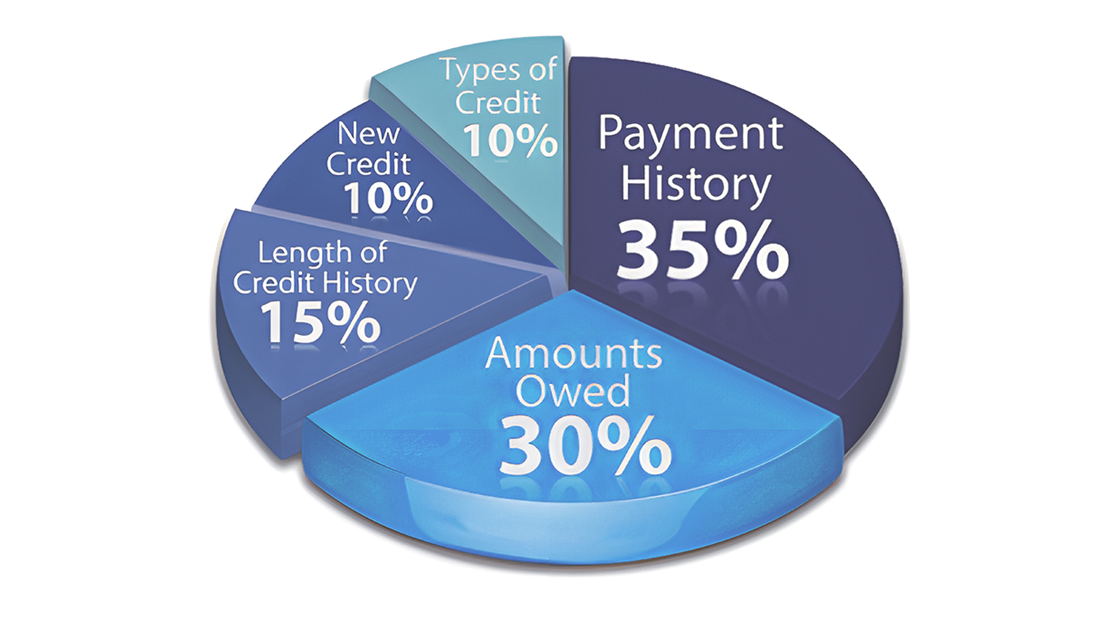
1) Payment History
Highest impact • ~35% of FICO®

What it is
Your record of paying accounts on time (late payments, collections, charge-offs, bankruptcies).
Credit impact
Largest weight (~35%). Recent/frequent/severe delinquencies hurt most; clean history powers the highest scores.
How it’s calculated
Severity (30/60/90+), recency, frequency, and derogatory public records/collections.
Healthy benchmark
100% on-time payments; no past-due balances.
How to improve
Autopay at least the minimum, reminders, bring delinquencies current, prevent bills from going to collections.
Common pitfalls
One-day-late payments, forgetting small/medical bills, assuming deferments always report as “on-time.”
2) Amounts Owed (Utilization)
High impact • ~30% of FICO®
What it is
How much of your available credit you use—especially on revolving credit cards.
Credit impact
~30% weight. Higher utilization = higher risk. Both overall and per-card utilization matter.
How it’s calculated
Overall revolving utilization, per-card utilization, number of accounts with balances, and installment loan balances vs. original amounts.
Healthy benchmark
<30% overall and per card; single digits (<10%) ideal for top scores.
How to improve
Pay before statement close, make mid-cycle payments, responsibly raise limits, avoid maxing out; don’t close good cards you use.
Common pitfalls
Letting one card report 80–100%, closing a card and shrinking total limit, thinking you must “carry” a balance (you don’t).
3) Length of Credit History
Moderate impact • ~15% of FICO®

What it is
How long you’ve used credit: oldest, newest, and average age of accounts, plus time since last activity.
Credit impact
~15% weight. Longer, positive histories are favored; grows with time.
How it’s calculated
Combines age of oldest/newest accounts with average age and recent activity.
Healthy benchmark
Preserve long-standing accounts in good standing; keep them lightly active.
How to improve
Avoid closing your oldest healthy cards; consider product-change instead of closing to keep history.
Common pitfalls
Opening several new cards at once (drops average age), closing your oldest card, long inactivity.
4) New Credit
Lower impact • ~10% of FICO®
What it is
Recent hard inquiries and newly opened accounts.
Credit impact
~10% weight. Hard pulls are small/temporary; new accounts can also reduce average age.
How it’s calculated
Counts hard inquiries (last ~12 months) and new accounts. Rate-shopping (mortgage/auto/student) within a short window is treated as one inquiry by many FICO versions.
Healthy benchmark
Apply only as needed; cluster loan quotes in a short window; use soft-pull prequal where possible.
How to improve
Space out applications; avoid opening several cards at once; let inquiries age off.
Common pitfalls
Multiple card apps in a month; assuming all pulls are soft; mixing many account types at once.
5) Credit Mix
Lower impact • ~10% of FICO®

What it is
The variety of accounts you manage—revolving (cards/retail), installment (auto/student/personal), mortgage, etc.
Credit impact
~10% weight. Demonstrating you can manage different types helps at the margin; not required to have everything.
How it’s calculated
Types present and your track record with them. Strong payment history outweighs having many types.
Healthy benchmark
At least one active revolving account in good standing; mix grows naturally with needs (auto, mortgage).
How to improve
Don’t open debt just for “mix.” Keep a low-utilization card active; let installment loans age and pay on time.
Common pitfalls
Closing your last credit card; opening finance-company accounts you don’t need.
Next step
Track & improve
Ready to apply this? Monitor your profile and act fast when things change.